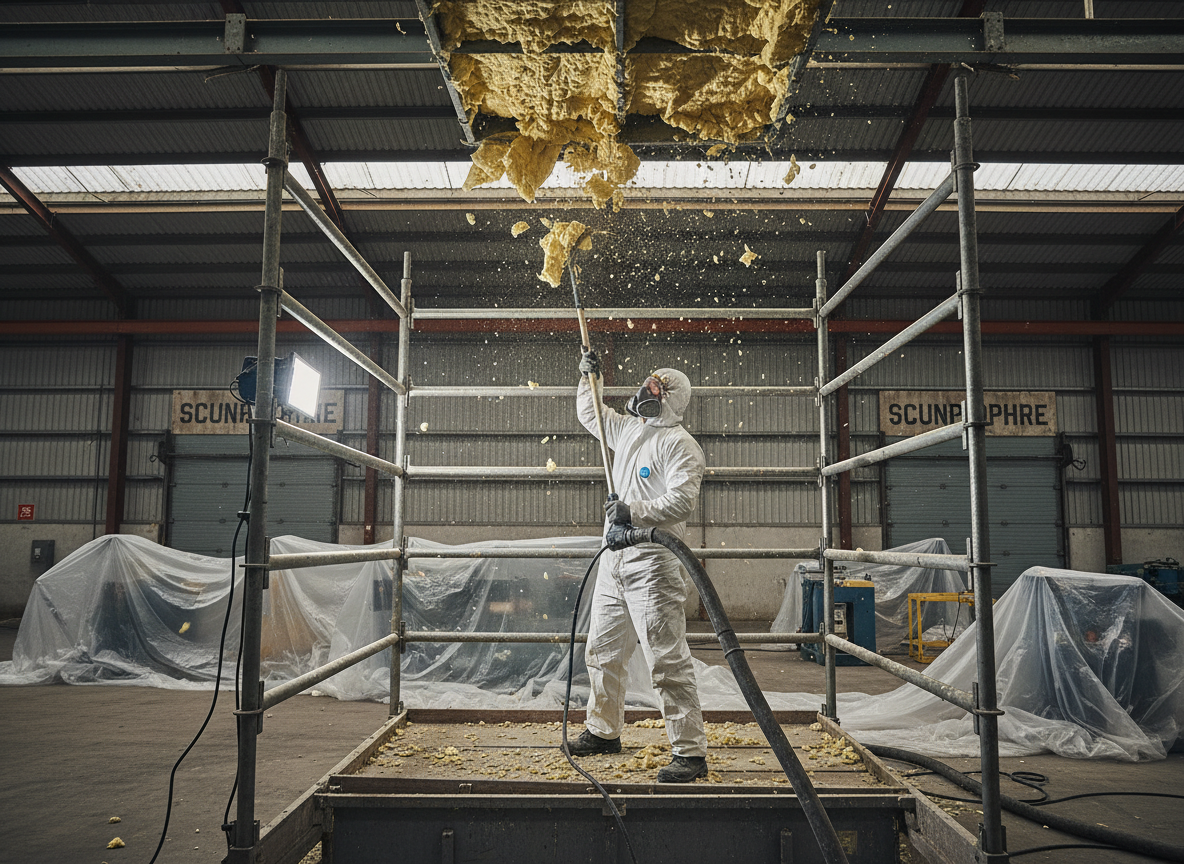
Warehouses in Scunthorpe often feature steel portal frames and corrugated roofing installed from the 1960s onward. Spray foam applied to these roofs creates hidden moisture traps where condensation from the nearby steelworks meets the closed-cell material, leading to corrosion along purlins and eaves. Removal requires cutting the foam in controlled sections to avoid releasing particulates into the workspace below while protecting electrical runs and sprinkler systems common in these buildings.
North Lincolnshire's older distribution sheds frequently have foam retrofitted over existing insulation boards. This layered construction complicates extraction because the foam adheres unevenly to bitumen and metal, leaving residue that must be mechanically scraped before any new lining can be installed. Workers must also account for restricted access in high-bay areas where cherry pickers cannot reach every valley gutter without temporary platforms.
Edge cases include warehouses near the River Trent where rising damp has already softened the lower foam layers. In these situations the removal sequence starts at the base and works upward to prevent saturated chunks from falling onto stored goods. All waste must be bagged on site because local disposal rules treat mixed foam and metal debris as special waste.
Proper sequencing also protects the building envelope during winter months when Scunthorpe temperatures drop quickly. Foam left partially removed overnight can trap frost against steelwork, accelerating rust that only becomes visible months later. Experienced crews therefore complete each bay fully before moving to the next.
Technician insight
In Scunthorpe, the thing that catches most people out with Warehouse spray Foam removal is the way older steel-framed sheds near the steelworks trap condensation under the foam along the north-facing slopes. That constant damp makes the foam bond far tighter to rusted purlins than anyone expects, so you end up scraping twice as long and still have to treat the steel before any new lining goes on.
High-Bay Unit Near the A15
Foam had been sprayed over the entire roof of a 1970s distribution shed and was trapping moisture against the steel. Inspection showed widespread surface rust along the valley gutters. We set up negative pressure zones, removed the foam in full bays, cleaned the metal, and left the interior ready for new insulation without interrupting the tenant's storage operations.
How it works
- 1
Site Assessment
Walk the warehouse roof and interior to map foam thickness, identify steel condition, and note any existing services or stored inventory that must remain protected.
- 2
Containment Setup
Install dust barriers and negative-pressure zones beneath the work area to keep particles out of active warehouse operations.
- 3
Sectional Removal
Cut foam into manageable panels, lower them safely, and mechanically clean residual material from metal surfaces without damaging coatings.
- 4
Waste Segregation and Disposal
Bag all foam and debris on site, label according to local rules, and remove from Crown Buildings base location for compliant disposal.
- 5
Final Inspection
Check every bay for remaining residue, photograph cleaned surfaces, and provide the owner with a written record of the cleared areas.
Pricing
Pricing depends on warehouse square footage, foam depth, and access restrictions; site visit required for accurate assessment.